Posts

What I learned at Data Science Bootcamp

Image
Ottawa is where I attended the bootcamp. Photo by  Shanta Rohse  via  Wikipedia About a week ago I was fortunate enough to attend a Data Science Bootcamp hosted by a gracious and affable local Data Scientist . It turns out that many people within her network of family and friends were desperate to learn more about Data Science. What better way to educate all the interested people than to bring them all into one room? Here in Ottawa, Ontario, the federal government is the largest employer, with two major universities supplying many graduates for the public servant workforce. This resulted in a crowd composition of mostly government workers; incidentally many had a Biology background (one biologist friend brings another biologist friend, etc. etc). Our host went around the room to assess our goals for attending her workshop, and it appeared as though we were all keen learners who simply wanted to learn more! She gave three wonderful presentations, and invited a han...

Data quality assurance requires real users

Image
A hard lesson that I've learned over the past few months is that data quality assurance requires real data users. I wrote a handful of data processing scripts two years ago to batch parse literature citations. The workflow was functioning well, and I even ran multiple test runs on different kinds of references to find bugs. I've returned to these scripts and started processing new sets of data. I've found that the resulting datasets are riddled with problems . Some references are skipped entirely by the workflow, with no flagging system, and other features I excitedly added to the scripts are now broken. This lesson has come to bear on my work a number of times, with software and workflows written by other, highly competent folks. You just can't predict what the problems with your workflow will be, until you have real users. What is the solution here? I hope I will find some clarity soon. 

Data visualization: biodiversity science vs. business

Image
Since my transition from full-time business analytics back into biodiversity informatics, I've accumulated a few thoughts on the subtle, albeit major, differences in challenges posed by data visualization. Big data continues to pile up in every domain. While scientists have long collected and presented large sets of data as part of their research pipeline, new players are entering the data deluge realm. From small online companies to monolithic technology companies (e.g.,  Google, Apple, Facebook, Amazon, etc.) , many businesses are now clients of easy-to-use visualization tools that take data directly from its data store to beautiful live dashboards or linked stories (e.g., Tableau, Looker, Google Analytics). These are the sorts of tools I used as an analyst in the private sector. More available visualization tools can only mean good things for scientists, right? The differences between scientific datasets, data visualization goals and audiences and the visualization goals an...

Web design for science dummies

Image
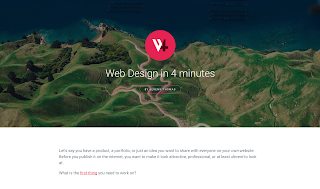
I'm currently working on a project to bring an old publication to new life on the web. We want it to be a dynamic, structured and integrated version of the paper copy publication. To have maximum value for researchers, it should be modern and user friendly. Web Design So, I've been diving into modern web design. The beautiful, easy-to-read and clean looking sites you see these days can be distilled into a surprisingly few number of principles. Fonts, centering, spacing, and images all have huge impact. Jeremy Thomas  took me on a 4 minute journey into the world of design. Thanks Jeremy! The look and feel of a modern webpage can be distilled into the following set of [paraphrased] rules: Focus on content Use clear readable text Utilize text colour for emphasis Add bold images Of course, the world of web design seems to be as fickle as fashion. Trends come and go, things become outdated and need refreshing. I believe the above principles, however, sho...

Why do so many programming languages exist?

Recently, I stumbled upon the answer to a question I didn't realize I had. Why do so many programming languages exist?  Programmers develop human-readable languages to more easily instruct the computer. Eventually, programming languages evolve. They are expanded, re-purposed, adopted by others, and proliferate. This leads to an accumulation of idiosyncrasies over time, making it difficult for newcomers to adopt the language as the learning curve grows and new versions arise (e.g., PHP). Hence, the need for modern languages. Built from scratch, they can be more approachable, and adapted to modern purposes. After all, the problems programmers need to solve change as rapidly as technology itself. The way I see it, the only language that will never change are the 0's and 1's themselves 😊